
From Radialsystem to Tempelhof – eight years of ICNC
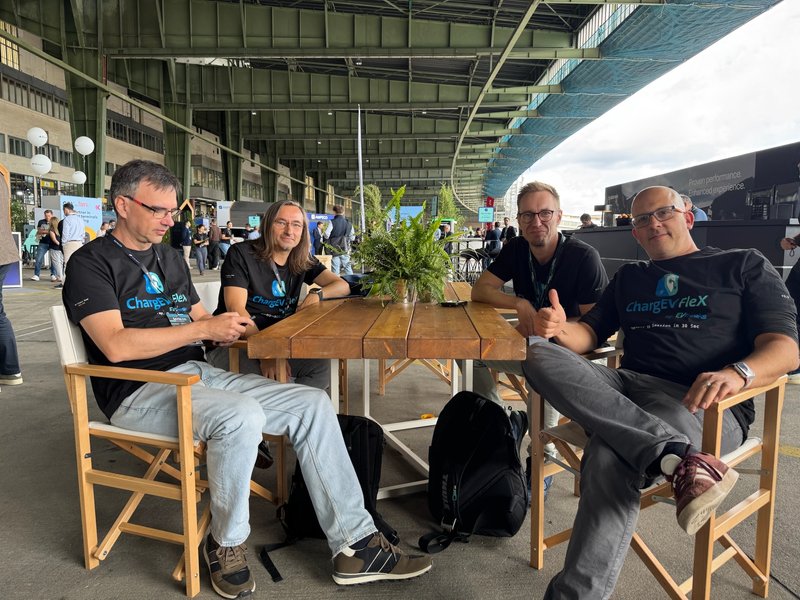
ICNC26 ran from 1 to 3 September in Berlin, and this time almost the whole team made it. That’s us under the hangar roof of Tempelhof airport: Ernesto, me, Olli and Felix. Only Roland was missing.
Felix and I were already there in 2018.
2018: Radialsystem, T-shirts among suits
ICNC18 took place on 7 and 8 June 2018 at Radialsystem V, right on the river Spree between Friedrichshain, Mitte and Kreuzberg. The motto was spelled out above the stage: “Embrace change. Future mobility now.” More than 1,000 attendees, invitation only, and a venue that looked more like an arts centre than a congress hall — because that is exactly what it is.
One correction to my own memory first: it wasn’t the first ICNC. The conference website said “for the 7th time”, and what is now the charging industry’s flagship event started in 2012 as a small get-together for intercharge partners. Our first, though.
We stood out. chargEV T-shirts and jeans, suits and blazers all around. The T-shirts were just what we wore. We’d built an app after work and put it in the store. And now here we were among the big companies.
You might expect to be politely ignored in that crowd. The opposite happened. Nobody treated us as outsiders. People were open and curious, and we’re still in touch with some of them today. In 2018 the charging industry was still small enough that two people with a good app were interesting.

Not quite two hours later, at the evening reception in the garden:

That’s what you go for. Not just the talks, but the conversations afterwards — and above all the evening reception. The gin bar was already famous in 2018 and lived up to its reputation. It was back in Tempelhof. The queue had certainly scaled along with the industry.
A flashback to the nineties
This felt pretty familiar. In 1995, when the commercial internet was taking shape in Germany, much of it was just as improvised.
That was the year I started a company with a friend. In the same year, in the back room of an old post office in Frankfurt’s Gutleutviertel, three networks connected their lines and called the result DE-CIX — today the largest internet exchange in the world. Back then it had three participants.
We were in Frankfurt too, setting up our server. It was a close-knit crowd, and anyone willing to help was welcome. At some point I needed a change on the router. The administrator shouted the central Cisco’s enable password across the room, and I typed in the configuration. Not because I was authorised to, but because nobody thought to ask.
Today that’s unthinkable, and rightly so. Shouting an enable password across the room isn’t exactly an access control model that scales. Back then, everyone knew everyone. As the industry grew, operations had to grow up too.
What grew up in eight years
The numbers are stark. When we stood at Radialsystem in 2018, Germany had roughly 13,500 public charge points, and one percent of new cars were fully electric — about 36,000 vehicles for the whole year.
At the start of August 2026 there were 212,064 public charge points with 9.22 GW of connected capacity. And in August 2026 alone, 68,930 battery-electric cars were registered in a single month, a share of 32.4 percent. Nearly twice as many in one month as in all of 2018.
More telling than the numbers, though, is what people talk about. In 2018 the problem was finding a charging station at all and somehow getting it to start. That was the use case. That’s what we built our app for.
That problem is largely solved. At ICNC26 the subjects were availability, reliability, billing quality — and pricing. Utilisation was the metric charging networks were measured by, no longer the number of charge points. There were sessions on fraud prevention, accurate billing and roaming that works day to day.
If you run software in production, this all sounds pretty familiar. It has to work reliably, the billing has to be right, and it has to pay for itself. Welcome to operations.
What became of chargEV 3
Our app followed the same path. chargEV 3 was built for the world of 2018: find charge points, filter them, compare them. It was good at that job, and it’s still available for it.
Finding stations alone isn’t enough for us anymore. Charging and billing are part of the job now. That’s why chargEV v4 became ChargEV FleX, and we’re now an e-mobility provider (EMP) ourselves. That changes quite a lot of what has to happen behind the app.
What ICNC26 was about
For ICNC26 at Tempelhof airport, the organisers announced around 10,000 attendees on site and online and more than 130 speakers. From an arts centre on the Spree to an airport hangar: that gives you a pretty good picture of how much the industry has grown.
Much of the programme came down to one question: how do we make connected charging infrastructure work reliably day to day and pay for itself?
- Economics. AMPECO CEO Orlin Radev put it as a choice of three in his keynote: reach scale, specialise defensibly — or plan an exit. Utilisation has become the metric acquisitions are judged by.
- Fragmentation. Hubject CEO Christian Hahn named organisational fragmentation as the real obstacle to bidirectional and smart charging. Grid operators, energy traders, fleets and charge point operators all have to coordinate. That’s where things get stuck. My take: a clean API alone won’t solve that.
- Price transparency. The AFIR rules require the price to be known before charging, broken down by component, and that roaming must not add cost simply because a session is settled across a border. A topic that concerns us directly.
- OCPI 2.3.0. The new version adds national access point data, accessibility information, and optional modules for payment and booking.
Plug & Charge
Plug & Charge got the most promotion. For us, it goes all the way back to ICNC18.
Back then there was a session on the brand-new standard. Huge screen, diagram after diagram, trust relationships, PKI, certificate chains. The talk was so dense it was barely legible even at 4K. Eight years on, Plug & Charge has made its way into regulation:
- chargecloud and Hubject announced a pilot for Plug & Charge on AC charging on the opening day, meaning workplace and car park charging. It still requires compatible hardware, compatible vehicles, and an EMP contract that supports Plug & Charge.
- From 1 January 2027, public AC and DC charge points that are newly installed or renovated must meet EN ISO 15118-20:2022. Anyone offering automatic authentication has to support both ISO 15118-2 and -20. Existing points are not covered retroactively.
I’d like to take a closer look at how well the standard balances security, complexity and convenience. Someone has to implement and operate all that PKI and those certificate chains, after all. That deserves a post of its own.
And us?
We arrived in 2026 with four people instead of two, and this time our product could handle charging and billing as well as show stations on a map. The T-shirts got an update. They say ChargEV FleX now.
What hasn’t changed is the conversations around the programme. In 2018 they happened in the garden at Radialsystem; in 2026, at a wooden table under the hangar roof.
If we met there and still have something to follow up on, get in touch.
Not installed yet? Take a look at ChargEV FleX and download it.